

- Non-Custodial Security Best Practices – How to Keep Your Funds Safe
- What Non-Custodial Really Means
- Understand the Role of Private Keys and Seed Phrases
- Use Hardware Wallets for Long-Term Storage
- Secure Your Recovery Phrase Properly
- Protect Against Phishing and Social Engineering
- Review Smart Contract Permissions Regularly
- Separate Daily Use and Long-Term Storage
- Keep Devices and Software Updated
- Use Multi-Factor and Multi-Signature Protection
- Verify Transactions Before Signing
- Understand That Responsibility Is Final
- How This Aligns With EU Regulatory Expectations
- Final Takeaway
#
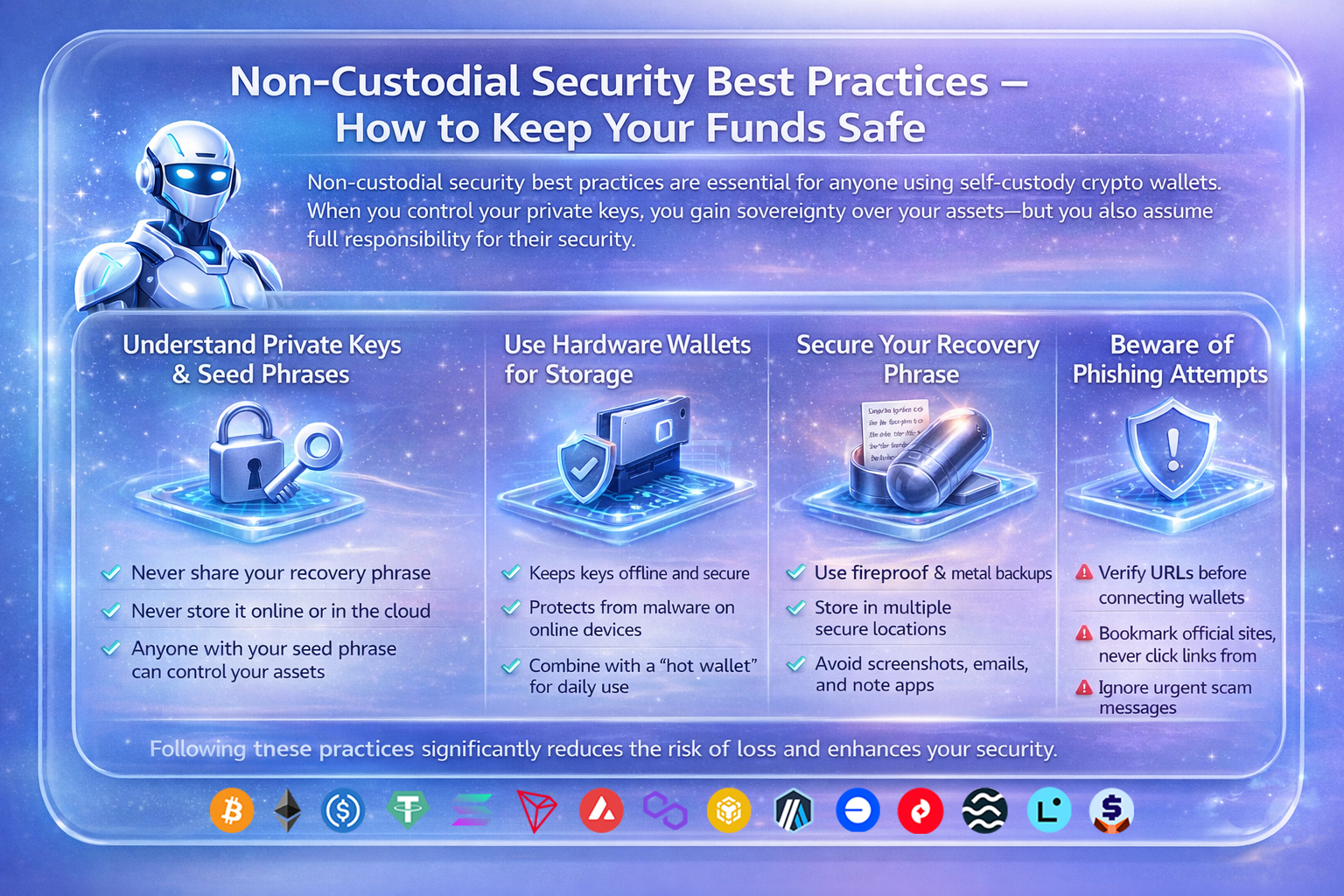
Non-Custodial Security Best Practices – How to Keep Your Funds Safe #
Non-custodial security best practices are essential for anyone using self-custody crypto wallets. When you control your private keys, you gain sovereignty over your assets—but you also assume full responsibility for their security.
Unlike custodial platforms, there is no customer support desk, no password reset, and no account recovery if mistakes are made. This guide explains how to protect your funds using proven, practical security principles.
What Non-Custodial Really Means #
A non-custodial wallet is a wallet where only you control the private keys. No third party can freeze, move, or recover your funds.
Common non-custodial wallets include:
- MetaMask
- Hardware wallets
- Mobile and browser-based self-custody wallets
- Smart contract wallets
If someone gains access to your private keys or recovery phrase, they gain full control over your funds.
Reference:
https://ethereum.org/en/wallets/
Understand the Role of Private Keys and Seed Phrases #
Your private key or recovery phrase is the cryptographic proof of ownership of your funds.
Security rule:
- Anyone with your seed phrase controls your assets
- No blockchain authority can reverse transactions
- No regulator or company can restore lost keys
Best practice:
- Never share your recovery phrase
- Never store it in plain text online
- Never upload it to cloud services
Use Hardware Wallets for Long-Term Storage #
Hardware wallets isolate private keys from internet-connected devices.
Why this matters:
- Malware cannot access keys stored offline
- Transactions require physical confirmation
- Attack surface is dramatically reduced
Best practice:
- Use hardware wallets for large balances
- Combine with a separate “hot wallet” for daily use
- Buy devices only from official manufacturers
Reference:
https://www.ledger.com/academy
Secure Your Recovery Phrase Properly #
Your recovery phrase is more important than your device.
Recommended storage methods:
- Write it on paper and store it in a secure location
- Use fireproof or metal seed backups
- Split storage across multiple secure locations
Avoid:
- Screenshots
- Email storage
- Password managers
- Notes apps
A compromised recovery phrase means permanent loss of funds.
Protect Against Phishing and Social Engineering #
Most crypto losses occur due to phishing, not protocol failures.
Common attack vectors:
- Fake wallet popups
- Malicious browser extensions
- Impersonation on social media
- Fake support messages
Best practice:
- Verify URLs before connecting wallets
- Never click wallet links from DMs
- Bookmark official sites
- Assume urgency is a red flag
Reference:
https://www.cisa.gov/topics/cybersecurity-best-practices
Review Smart Contract Permissions Regularly #
When you interact with decentralized applications, you grant permissions.
Risks include:
- Unlimited token approvals
- Dormant contracts with lingering access
- Malicious upgrades
Best practice:
- Revoke unused approvals
- Limit token allowances
- Review permissions after major interactions
Tools:
-
Etherscan Token Approval Checker
https://etherscan.io/tokenapprovalchecker
Separate Daily Use and Long-Term Storage #
Compartmentalization limits damage if something goes wrong.
Recommended setup:
- Hot wallet for daily transactions
- Cold wallet for savings
- No direct interaction between the two
This reduces exposure to exploits, malicious dApps, and accidental approvals.
Keep Devices and Software Updated #
Security vulnerabilities are constantly discovered.
Best practice:
- Update wallet software regularly
- Keep operating systems patched
- Remove unused browser extensions
- Avoid installing unknown software
Security hygiene is as important as cryptography.
Use Multi-Factor and Multi-Signature Protection #
Where available, add layers of authorization.
Examples:
- Hardware confirmation
- Multi-signature wallets
- Time-locks or spending limits
Multi-signature wallets require multiple approvals before funds move, reducing single-point failure.
Reference:
https://ethereum.org/en/developers/docs/smart-contracts/security/
Verify Transactions Before Signing #
Wallets do exactly what you approve—nothing more, nothing less.
Before signing:
- Check recipient address
- Review token amounts
- Confirm network
- Read transaction warnings
Blind signing is one of the most common causes of asset loss.
Understand That Responsibility Is Final #
Non-custodial security means:
- No chargebacks
- No reversals
- No third-party recovery
This is a feature, not a flaw—but only if you apply proper safeguards.
Treat self-custody like digital cash combined with bank-vault discipline.
How This Aligns With EU Regulatory Expectations #
Under EU frameworks like MiCA, non-custodial users retain responsibility for key management, while service providers must ensure transparency and risk disclosures.
MiCA does not prohibit self-custody, but it assumes users understand the risks involved.
Reference:
https://finance.ec.europa.eu/digital-finance/crypto-assets_en
Final Takeaway #
Non-custodial security best practices are not optional—they are fundamental.
By combining:
- Strong key management
- Hardware isolation
- Permission control
- Phishing awareness
- Operational discipline
You significantly reduce the risk of loss while preserving full financial sovereignty.
Self-custody rewards careful users and punishes complacency. Apply these principles consistently, and your funds remain under your control.


